
National City Resident Lookup Records
A sound one-person search begins by choosing the record that can answer the actual question. ARCC property information can connect an owner to a parcel, while a recorder index can name a party to a recorded instrument. The Superior Court index locates a case, not a result or a current address. Vital records confirm an event under California access rules. Business, FBN, and professional files show roles or affiliations. Voter status is a protected self-check. The table keeps those roles separate.
| Record | What It Confirms | Where | Access |
|---|---|---|---|
| Assessor property information | Ownership, property address, mailing address, parcel facts | ARCC Property Information / ParcelQuest | Phone, kiosk, or published assessor channel; owner display is limited online |
| Recorder index | Named party, party role, document type, recording date | ARCC Official Records | Free 1970-present name index; images and copies through kiosk or order; earlier records at Archives |
| Superior Court | Case number, party, type, filed date, location | San Diego Court Index | Free locator with exclusions; file and copy fees apply |
| Vital records | Birth, death, marriage, or family event and date/place | ARCC and CDPH | State coverage since July 1905; authorized or informational copy rules |
| Business entity filings | Entity, agent, officer, address, dated filing | California bizfile | Free public facts and images; role is not a home address |
| Fictitious business name | Local trade name and associated filer | San Diego County ARCC County Clerk | Request the county filing; not a household record |
| Professional license | License name, status, board disclosures, business or mailing clue | California DCA search | Free search; fields and disclosures vary by board |
| Voter status | Your own registration, status, address, and ballot details | California My Voter Status | Identity-gated self-lookup, not a third-party resident search |
Start with the least ambiguous clue. A known business name may lead to bizfile; a remembered event may lead to a vital copy; a case number is stronger than a common name. If an address is known, use the parcel and recorder channels, then test the person against a dated directory or court result. Two independent facts should agree before a name is treated as the same person.
Match the Right National City Resident
Same-name errors are the central risk in a National City name search. Match at least two stable details, such as a middle initial and city, a parcel and legal description, a spouse or trust name, a case date and location, or a license and business association. A recorder party can be a grantor, grantee, trustee, lienholder, or representative. A court party can appear in a case without living in National City. A property owner can have a mailing address in another city. Each record needs its role and date.
Begin with the clue that has the narrowest range. A rare business name can be checked in the Secretary of State file, then compared with a county FBN filing. A remembered school connection can be tested in a yearbook and newspaper rather than assumed from a surname. For a family link, use an official vital record or probate file when access rules allow it. A clerk can explain how to obtain a file, but will not validate that a person in one record is the person in another.
Use name variants carefully. Try initials, full given names, compound surnames, former names, trust names, and older spelling. Preserve the printed form in notes. Modernizing every name at the start can hide the match that a later source makes clear.
National City Court Index Search
National City trial matters are San Diego Superior Court records. The South County Division is at 500 Third Avenue in Chula Vista, but the returned case location controls where a file is housed. The online party search asks for a case category and location before the name. Narrowing by filed year, first name, or date of birth helps separate similar parties. The court offers Party Name Search, Case Number Search, and DA Number Search modes.
| Field | Type | Required | Options or format |
|---|---|---|---|
| Case Type | Dropdown | Yes | Limits the applicable case category |
| Case Location | Dropdown | Yes | Select the court location or division |
| Party Type | Dropdown | Conditional | Used for Civil or Domestic case types |
| Beginning Date Filed Year | Text | Optional | Four-digit year |
| Ending Date Filed Year | Text | Optional | Four-digit year |
| Last Name or Business Name | Text | Search key | More characters improve speed |
| First Name | Text | Optional | Use to narrow a same-name result |
| Date of Birth | Date text | Optional | MM/DD/YYYY where applicable |
Case Number Search uses Case Type, Case Location, and the case number. The current shortcut uses a four-digit year followed by an eight-digit sequence without hyphens. DA Number Search takes the DA case number. Pre-1974 cases are omitted from the public web index, juvenile and infraction matters are excluded, and some limited civil or misdemeanor locations expose only ten years. Older microfilm and courthouse terminals remain separate access paths.
The San Diego Superior Court party-name form shows the fields used for a name-based search.
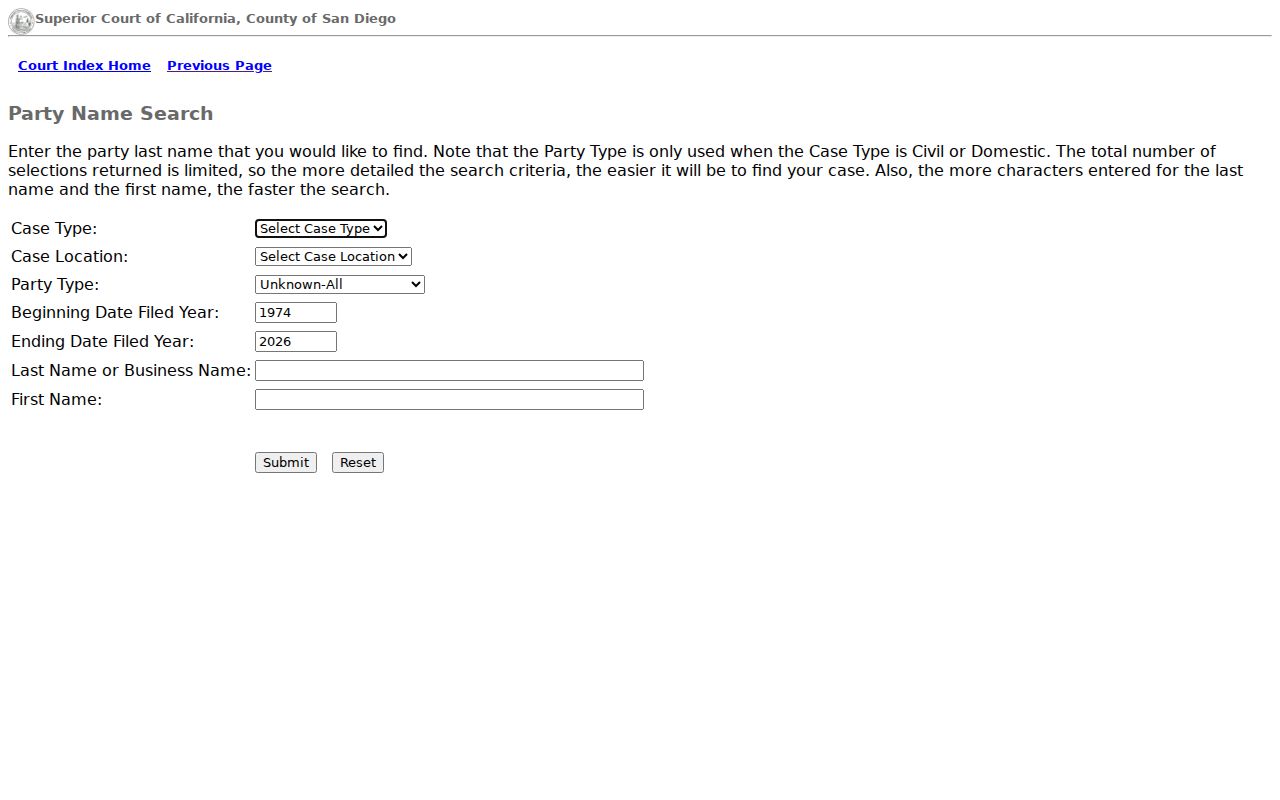
The form is a locator tool. A result should be copied with its case number, location, type, and filed date before any request for the underlying file.
Read a National City Court Result
A court index result can tell a National City name search where to look next, but it does not settle what happened. The visible record may show a case title and number, location, case type, date filed, party names and roles, and register-of-actions events where available. It may retain an entry after dismissal or a finding of no guilt. Charges and disposition are not supplied by the basic name result. Sensitive family, criminal, adoption, juvenile, and sealed material may be limited even when the index remains visible.
A useful docket inventory includes:
- case title, case number, court location, case type, and filed date;
- party names and roles, including business names where shown;
- register-of-actions events when the index exposes them;
- the exact missing item, such as a disposition, order, or charge, that requires the file;
- the access limit, such as a sealed, juvenile, adoption, or confidential submission.
Federal matters follow a different path. The U.S. District Court for the Southern District of California identifies the federal court, its divisions, and local filing information.
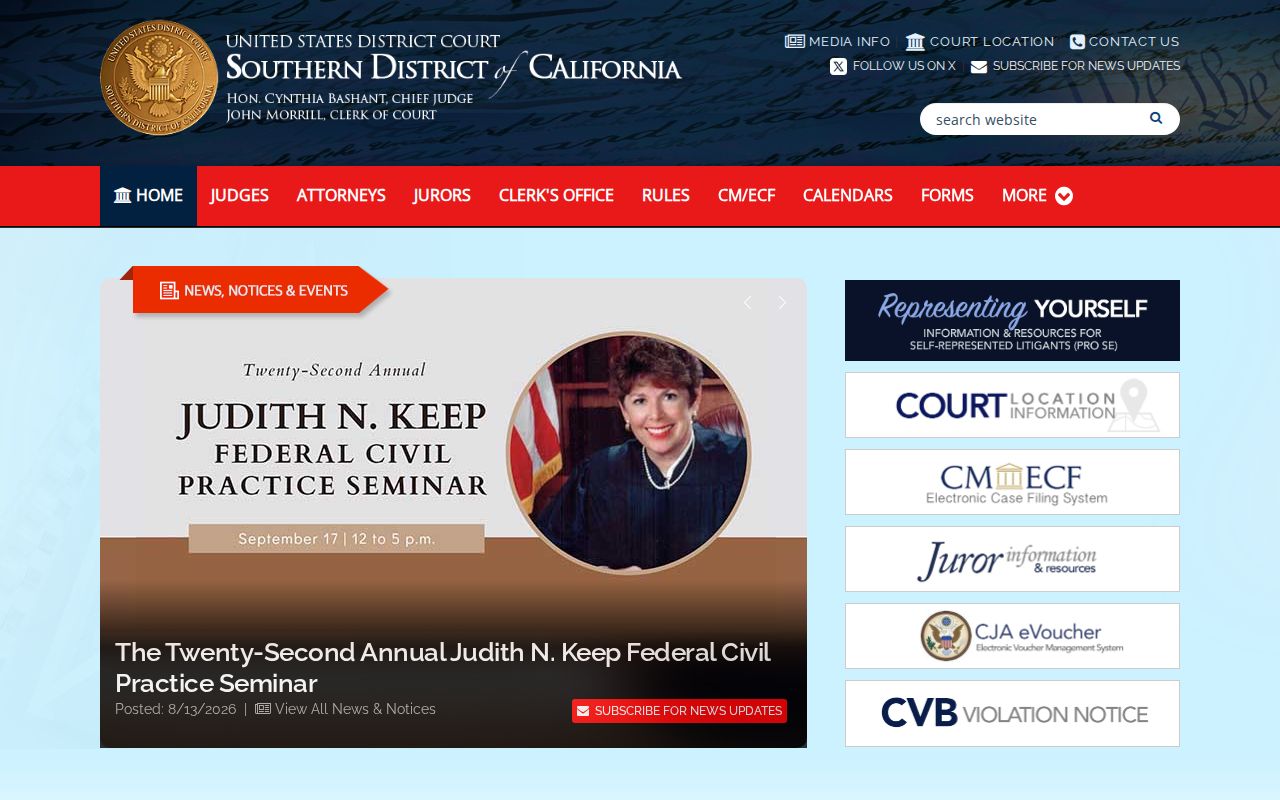
A Southern District result is not a San Diego Superior Court result. Federal case records are located through federal systems, with the court site supplying local context.
The PACER Case Locator supplies the federal index and document access framework.
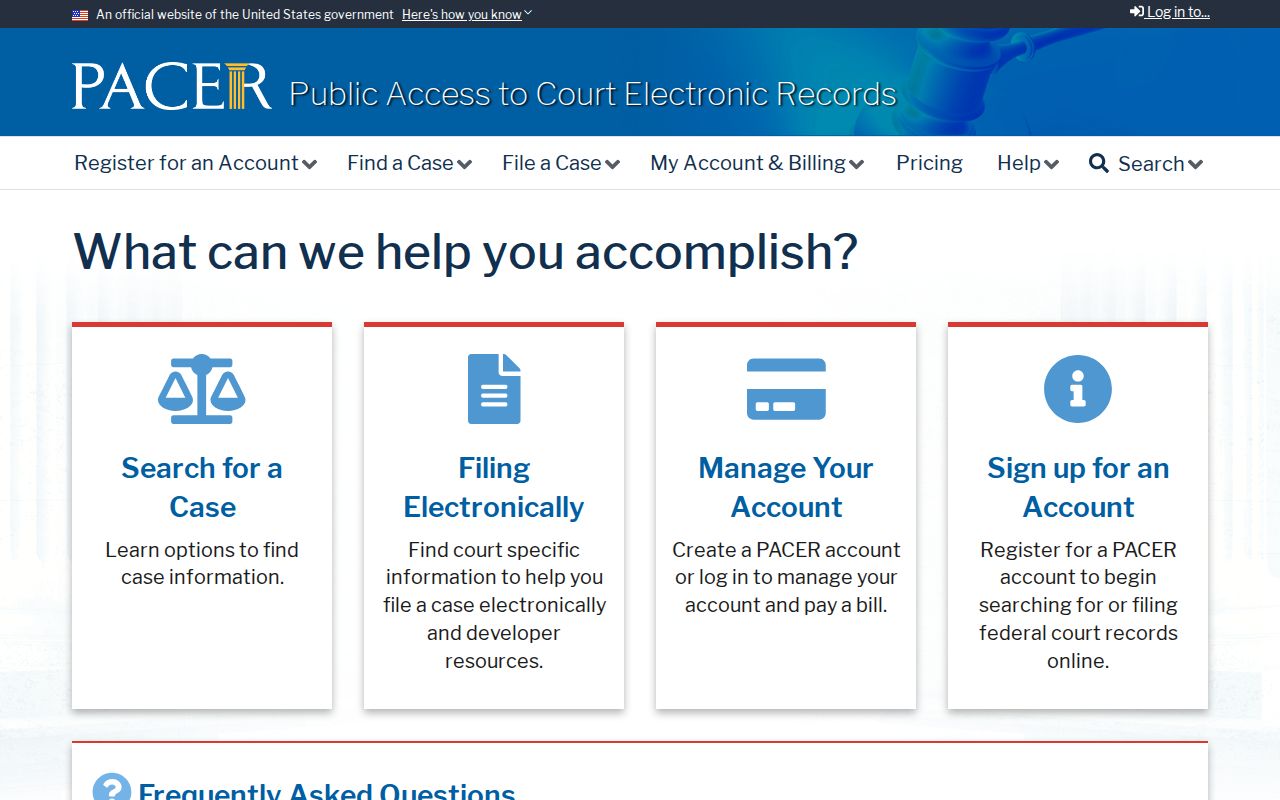
PACER generally charges $0.10 per page, caps a document at $3, and waives quarterly charges of $30 or less. Treat the federal index as a separate source with its own billing and document rules.
Obtain a National City Court File
When a court result matters, request the official file from the location returned by the index. San Diego Superior Court file viewing requires identification, and cameras are not allowed. A request or transaction is limited to ten cases. Ordinary copies cost $0.50 per page, certification costs $40 per document, and a search taking more than ten minutes costs $15. Older offsite files may add retrieval time and cost.
- Docket
- The court’s running record of a case, including entries that show filings or events without supplying every document.
- Index versus image
- An index is a locator with selected fields. An image is a scan or copy of a filed document and may require a separate request or fee.
- Certified copy
- A copy issued with the clerk’s certification that it matches the court record. It is different from a screen view or ordinary photocopy.
- Register of actions
- A case event list that can show filings or orders when the court makes those entries available.
Mail requests need the case number, parties, exact documents requested, requester contact information, a self-addressed stamped envelope, and a check with a not-to-exceed amount or an ADM-253 card form. The court does not deliver copies by fax or electronic file transfer. A specific document request is more useful than asking for an entire record without a case number.
The Superior Court file request instructions state the inspection and copy path.
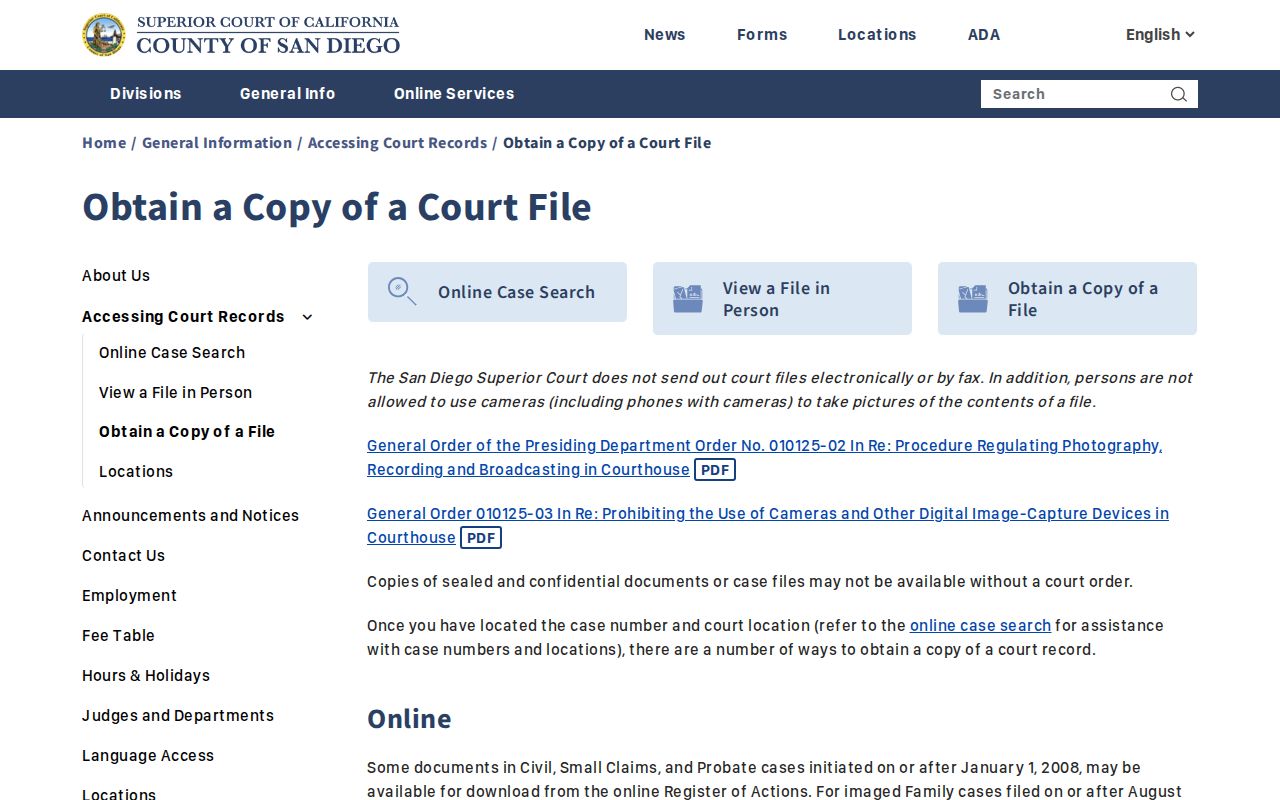
The file request route is the step that turns a docket clue into an official document, subject to the court’s access limits and any redactions.
Order National City Vital Record Copies
California does not open vital records through one simple age rule. San Diego County ARCC issues local birth, death, and marriage copies, while CDPH maintains statewide birth, death, fetal death, marriage, and divorce records from July 1905 forward. Authorized certified copies require a qualified requester and sworn statement under Health and Safety Code sections 103525-103526.5. Other requesters may generally order an informational copy marked not valid to establish identity. Confidential marriage records come only from the issuing county to a party or by court order under Family Code section 511.
| Record | County 2026 fee | State 2026 fee | Access note |
|---|---|---|---|
| Birth | $32 | $31 | Authorized or informational copy |
| Death | $24 | $26 | Authorized or informational copy |
| Public marriage | $17 | $19 | Authorized or informational copy |
| Confidential marriage | Varies | Not the state route | Issuing county party or court order |
| Divorce abstract | Superior Court file | $18 | Abstract is not the decree or full court file |
The local registrar handles a birth or death in the current year and preceding year, while the Recorder holds older local years. CDPH suggests county ordering during the first three months after a birth or death and first six months after a marriage because the county route may be faster. State processing is currently 4-6 weeks. VS111, VS112, VS113A, and VS113B ask for the event name, date, place, parents’ birth names where relevant, requester relationship, purpose, eligibility, signature, and mailing details.
A mailed authorized request needs the required sworn statement notarized. Send a check or money order to CDPH-Vital Records, MS 5103, PO Box 997410, Sacramento, CA 95899-7410. Certificates are not emailed, faxed, or sent as scanned files. If no record is found, the fee is retained and a Certificate of No Public Record is issued. A state divorce abstract does not replace the Superior Court decree.
Verify a National City Address
A current-address question needs more than an owner name. ARCC assessor channels distinguish the property or situs address from the owner’s tax mailing address, and either can differ from the place where a person lives. Use a parcel as a bridge to a recorded deed, then compare the dated result with another source. Since December 9, 2024, APN searching was removed from the online recorder index under AB 1785, but the five public ARCC kiosks retain APN search and image access.
- Start with the known name, address, or parcel in ARCC property information, using the phone or kiosk route when online ownership display is limited.
- Use SanGIS/SANDAG to inspect the physical parcel, save the APN, and separate the situs address from the mailing address.
- Search the owner or entity as grantee in the ARCC recorder index, trying middle initials, trust names, business names, and older abbreviations.
- Record the document number, recording date, grantor, grantee, document type, and legal description, then view the image at a kiosk or order a copy.
- Compare the deed clue with a court date, directory entry, census snapshot, newspaper item, or other dated record before calling the person a current resident.
When the question expands from one person to every address along a road, use the National City street directory workflow instead. The same APN can guide both tasks, but the resident lookup should keep its focus on identity and verification.
Special National City Lookup Paths
Different personal questions call for different local sources. A single name search is too blunt for an heir, classmate, business owner, or birth parent. Use the record category that naturally holds the relationship, and respect the access rule before asking for a copy or contact.
- Heir: search the Probate Court Index, inspect the petition, notices, orders, and other available file material, then compare an obituary. The Recorder does not hold wills or probate files.
- Former classmate: use National City High School yearbooks from 1910-20, Sweetwater volumes from 1921 forward, National City Junior from 1954-91, or National City Middle from 1992 forward, then check newspapers for a dated tie.
- Business owner: search California bizfile by entity name or file number and add a San Diego County FBN filing when a local trade name is involved. An entity role does not establish a home address.
- Birth parent or adoptee: use the California Department of Social Services Mutual Consent Program, not a public name search. An adult adoptee and birth parent must both consent before contact information is disclosed, and AD902 is the relevant form.
CDSS routes unknown-agency questions to the Post Permanency Services Unit at 744 P Street, MS 8-12-521, Sacramento, CA 95814, 916-651-8089, or cdsspostadoptionservices@dss.ca.gov. The program cannot solicit consent or act as a private searcher. Local yearbooks, obituaries, and the Kile Morgan collections can supply clues without turning a protected relationship into an open lookup.
National City Business and License Clues
California bizfile is useful when a National City resident is known through an organization. Search by entity name or file number, then narrow by entity type, status, initial filing date, prefix mode, or other published filters. Results can show the entity name and number, formation or registration date, jurisdiction, status, agent, street or mailing address, Statement of Information due date, and officers, directors, members, or managers. Plain facts and images are generally free; certified or status products cost extra.
Bizfile does not list shareholders generally, employees, sole proprietors, phone numbers, email addresses, or Social Security numbers. A city business-license application may contain a physical location, owner or officer details, state license information, and a business description, but no verified open city-license register was found. Use the City Clerk’s records request route for an existing record and expect sensitive identifiers to be withheld.
The California Department of Consumer Affairs umbrella search can verify a license name, number, status, city, or business where the board publishes that field. Board disclosures vary. Status dates matter: an expired license may prove an older affiliation without proving a current one. Pair a professional record with a dated business filing, court result, or local directory entry rather than treating the license as a residence record.
National City Lookup Privacy Walls
Some dead ends are designed access limits. California My Voter Status authenticates the voter’s own registration, address, party preference, ballot status, polling place, and election information. It is not a way to confirm a neighbor. The full voter file is purpose-restricted under Elections Code sections 2188.5 and 2194 and 2 CCR sections 19001-19013. A formal file request requires an allowed election, scholarly, journalistic, political, governmental, or record-review purpose, proof, a security plan, fees, agreements, and a wet signature. A personal wish to identify everyone at an address is not a shortcut.
Safe at Home can create a confidential address for eligible survivors of domestic violence, stalking, sexual assault, trafficking, child abduction, elder or dependent-adult abuse, and certain threatened public or reproductive-health participants. The substitute address works for mail and qualifying agency or court use, and Government Code section 6209.5 can replace a residence address on some property documents. It does not erase older records or reveal a protected person through another index.
When a needed municipal record is not posted in National City Laserfiche, the City Clerk’s NextRequest channel is the CPRA fallback. California Public Records Act sections 7920.000-7931.000 generally require a response within ten calendar days, with a possible fourteen-day extension for unusual circumstances, followed by production in a reasonable time. Narrow the request by department, record type, address or APN, date interval, and desired format. A request asks for an existing record; it does not require an agency to create a new resident list.
For a historical name trail, the National City directory collections can provide a dated source when current online records are closed or too thin. A closed index is a signal to change custodians, not to guess.
Lawful National City Resident Lookup
Use a National City name search for a lawful personal purpose, such as family history, reconnecting through an appropriate channel, checking a record about yourself, or studying local history. Match the record to the right person and stop when the custodian’s rule says the information is protected. Do not use a name, address, court clue, vital record, or voter detail to stalk, harass, intimidate, or surveil another person.
Lawful use. California Penal Code section 646.9 addresses criminal stalking, and Civil Code section 1708.7 provides a civil remedy for a pattern intended to follow, alarm, surveil, or harass that causes fear or substantial distress.
Public-record status does not make every use lawful or every conclusion sound. Court indexes can outlast a case outcome, a deed can name an owner without naming occupants, and a voter tool can authenticate only the voter using it. Verify significant facts with the ARCC, court, CDPH, city, or state custodian before relying on them.