
National City Directory Collections
The Kile Morgan Local History Room is the local starting point for a National City historical directory search. Its official holdings list San Diego County and City Directories from 1889-1984, alongside maps, newspapers, yearbooks, deeds, photographs, and community papers. The library page lists Tuesday and Thursday hours from 1-3 and also uses appointment-only language. Call 619-470-5870 or email localhistory@nationalcityca.gov before traveling so the room can confirm access, the needed volume, and any handling rule.
| Collection | Years | Where Held | Access |
|---|---|---|---|
| County and city directories | 1889-1984 | Kile Morgan Local History Room | Appointment; confirm the volume and hours |
| Olmsted and Bynon National City section | 1892-93 | Digitized and transcribed copies | Online scan; check the page image |
| R.L. Polk city and suburban runs | Verified 1952, 1955-60 | San Diego City Archives and library collections | Digitized runs; complete annual coverage is not promised |
| National City newspapers | 1882-present | Kile Morgan microfilm and digital newspaper collections | Read film or digital pages; verify OCR |
| School yearbooks | 1910-present, by school | Kile Morgan and selected digital copies | School runs vary; inspect the named year |
| Sanborn fire-insurance maps | 1887-1927 | Kile Morgan microfilm and Library of Congress | Local access and selected online sheets |
| Federal census schedules | 1790-1950 | National Archives and library genealogy access | Public schedules; household snapshots |
| Kimball Family Papers | 1854-1934 | Kile Morgan and digitized diaries | Room access or selected digital material |
The table describes distinct evidence sets, not one master resident register. A printed listing may show a householder while a deed names an owner, a census counts a household, and a newspaper records a visit or death. Keep the date and the role attached to every clue.
The 1892 National City Listing
The dedicated early volume is titled Directory of San Diego City, Coronado and National City, 1892-93. S.H. Olmsted and A.A. Bynon gave National City its own section instead of hiding every local listing inside a wider county alphabet. That separation makes the book useful for tracing a small place, while the surrounding publication still shows how the South Bay was connected to San Diego's business and transport network.
The San Diego City Archives directory collection is the best public starting point for digitized runs and their page order. A scan can reveal a heading, a street phrase, and the next name on the page, details that a bare transcription may lose.
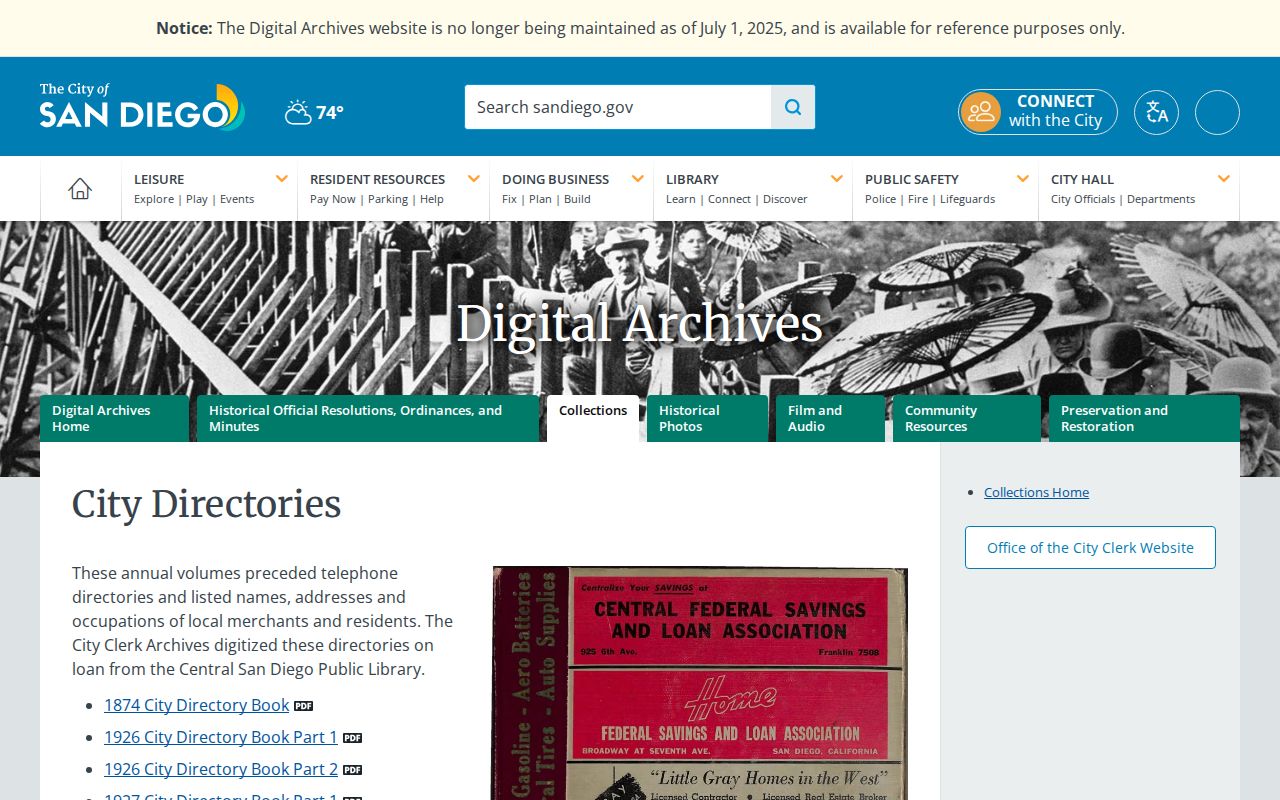
The digitized collection places the local volume in a wider run of regional books. Use the volume label and page image together, because a regional title may contain a local section without offering a separate annual National City book.
Read a National City Listing
A printed entry is a compact bundle of clues. The name may be followed by an occupation, a business connection, and a residence. The residence line can use “res,” “near,” “between,” or “corner” rather than a modern street number. Women may appear as Mrs. or Miss, and churches, banks, rail offices, and other institutions can be interfiled with personal names. Read the full line before treating a word as a surname, street, or business.
| Entry feature | What it can show |
|---|---|
| Name and initials | The printed form of a person’s name in that year |
| Occupation or affiliation | A work role, office, partnership, or civic connection |
| Residence phrase | Street, nearby avenue, corner, or between-streets clue |
| Business office | A separate place of activity from the residence |
| Institutional entry | Bank, church, agency, or other named organization |
Four short examples show the range. “Adair, J C” is described as a track foreman for the N C and O Ry and lives on Fifth Avenue near Eighteenth. A.G. Adams is tied to real estate and insurance, National City Abstract Co., People’s State Bank, and a residence near Third and Twelfth. G.W. Beermaker is tied to The Record Co. and notary work, with an F Avenue residence between Fifth and Sixth. The Bank of National City entry names its president, vice-president, and cashier and places the institution at Seventh and Twenty-first.
Those details are leads, not proof of a present address. A business office can differ from a home, and a corner phrase needs to be placed against a period map or another directory.
The 1892-93 directory scan lets a reader compare the transcription with the printed page.
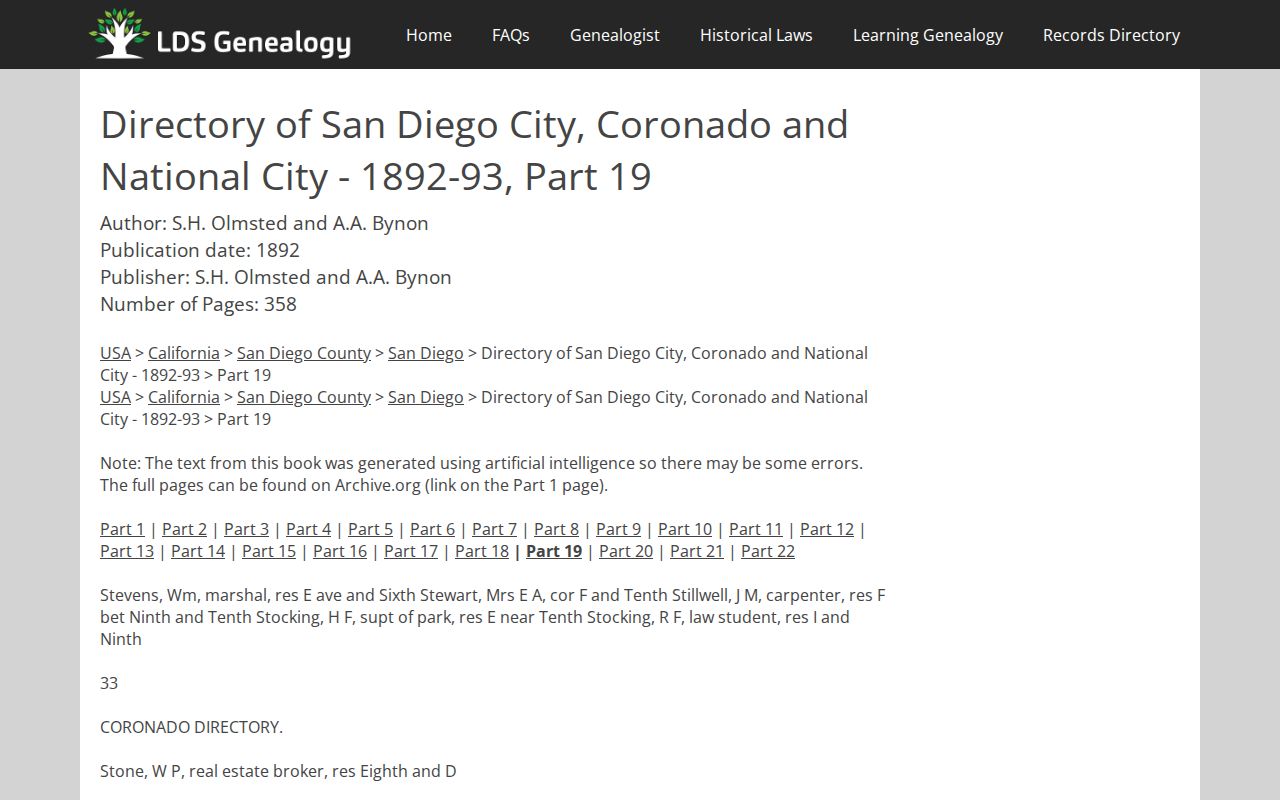
The page image preserves type, punctuation, and the order of adjacent entries. That context helps separate an address phrase from a business line when OCR has joined them.
Polk Volumes and Householder Indexes
Later National City directory work often depends on the R.L. Polk city and suburban runs. Verified local examples include 1952, 1955-60, and a 1957 National City Householders Directory section. The alphabetical pages start with a name. A reverse or householder section starts with a street or address and can answer a different question: who was listed at a place during that canvass?
The digitized San Diego runs list annual and suburban volumes such as 1926-43, 1944-45, 1947-48, 1950, 1952, 1953-54, 1955 Suburban, 1956 city and suburban, 1957 city and suburban, 1958 city and suburban, 1959 Suburban, and 1960 Suburban. National City appears in the relevant regional or suburban books. The run list supports a targeted search, not a claim that every National City year is on the shelf or online.
- Criss-cross directory
- A reverse directory that turns an address or street into a householder name instead of starting with the name.
- Householder index
- An address-first section naming the person listed at a home or place for a particular canvass.
- Abbreviation key
- A reader’s list of short forms used by the publisher for streets, railways, companies, occupations, and other repeated terms.
Read the alphabetical and reverse sections as companion tools. One may identify the person; the other may test the address. Their agreement is stronger than either entry alone.
Searching National City Directories
A household-across-years search works best when each result is copied into a small timeline. Begin with the strongest known clue, but keep alternate spellings and nearby streets in view. The goal is not to force every volume to agree. It is to see when a name, address, and household pattern overlap.
- Start in an alphabetical local directory with the person’s surname, given name, initials, and any known association.
- Write down the exact residence phrase, occupation, business office, spouse form, and street words before modernizing anything.
- Move to a reverse or criss-cross section for the same year and read the address entry around the target place.
- Compare the closest earlier and later volumes, marking an arrival, departure, changed name, or gap as a dated possibility.
- Pair a directory year with a census year when possible, then use newspapers, yearbooks, or a deed to test the link.
- Check a period map when “near,” “between,” or “corner” language does not fit today’s street layout.
For a modern address-keyed trail after the historical clue is found, the National City street directory workflow connects parcel, assessor, recorder, and permit evidence. Keep the historical book as the dated source rather than rewriting it to fit a current map.
Why National City Directory Gaps Mislead
A gap in one local directory does not settle where a person lived. The 1892-93 publisher warned that removals and changes during canvassing could affect the printed list. A person may have been missed, declined to answer, changed a name, moved between canvass dates, or appeared under an institution or business entry. A reverse section may also cover a different area than the alphabetical section.
Reading rule. Treat presence as a dated lead and absence as a question that needs another source, not as proof that a household left National City.
Publisher coverage also varies by volume. The local history page confirms a directory shelf from 1889-1984, but it does not publish a complete annual shelf list with every publisher and reverse section. Ask Kile Morgan staff to confirm the exact year before building a research plan around it.
Newspaper notices, deeds, maps, and school records can bridge the blank. The bridge should retain the source date and the source’s role, because a directory householder, a deed party, and a newspaper correspondent are not interchangeable labels.
National City Newspapers and Yearbooks
The local newspaper sequence gives directory research a second time line: National City Record from 1882-1902, National City News from 1903-55, Star-News from 1956-95, and Star News from 1996 to the present. Notices of marriages, deaths, arrivals, clubs, school events, and civic work can explain a directory change. OCR is a finding aid only. The printed scan controls spelling and dates.
Yearbooks add a human layer. National City High School has a 1910-20 run; Sweetwater yearbooks extend from 1921 forward; National City Junior covers 1954-91; and National City Middle continues from 1992. Club scrapbooks, organization directories, and about 4,500 photographs in the Kile Morgan holdings can add a face, a school activity, or an affiliation to a name that appears in print.
The National City Historical Society visit information identifies the Frank Kimball Museum and Brick Row as local history contacts.
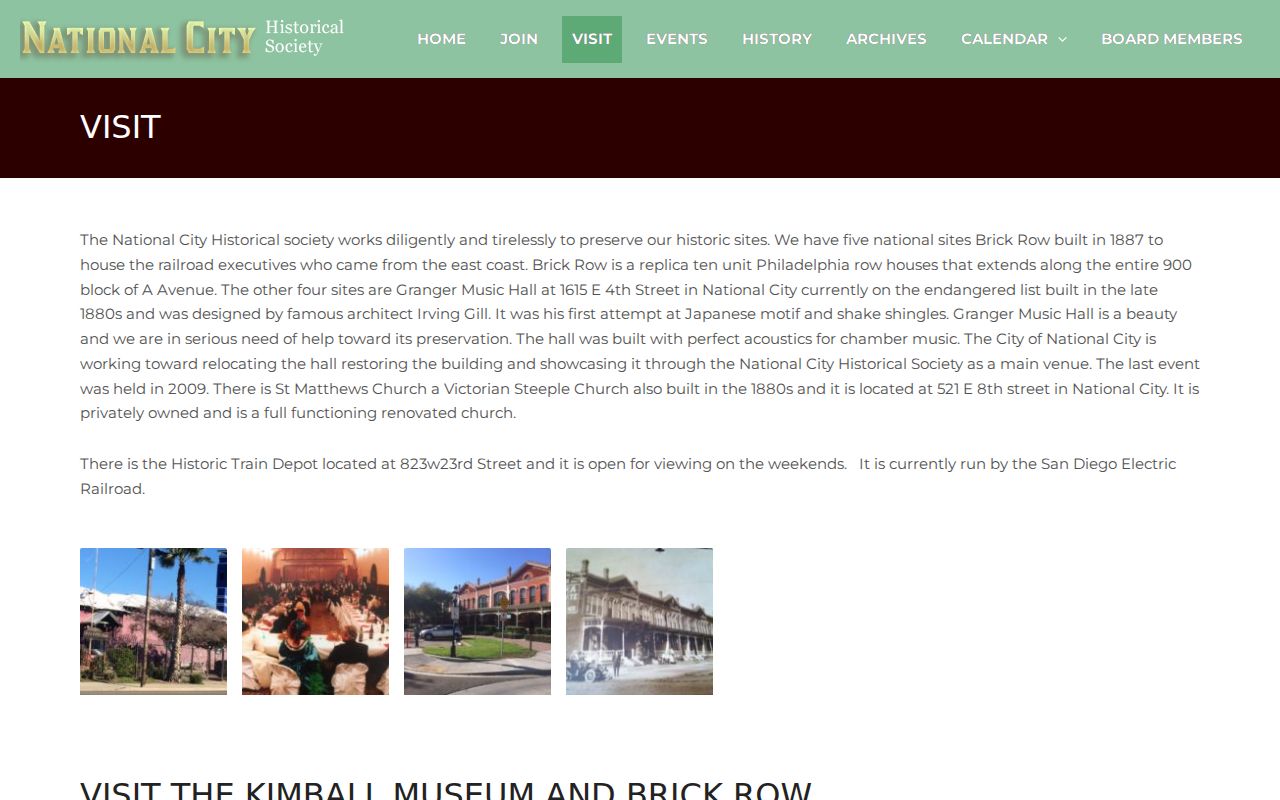
The Historical Society supplies community-history context and visit information. Its public page does not establish a formal Historical Society resident lookup service or a complete manuscript finding aid, so directory questions belong with Kile Morgan staff and the source volume.
Sanborn Maps and National City Census
Sanborn fire-insurance maps add the building behind a local listing. Local holdings cover 1887-1927, and the Library of Congress has a digitized 1911 National City atlas with thirteen sheets. A map can show a footprint, use, lot context, or street relationship. It cannot name every occupant. Census schedules, public through 1950, provide a household snapshot at a decennial moment, but the address may need to be normalized against the period map.
- 1854: Kimball Family Papers begin the local documentary trail.
- 1868: National City maps mark the Kimball-era land context.
- 1871: Local deeds and mortgages add property evidence.
- 1882: The local newspaper sequence begins with the Record.
- 1887: Sanborn and municipal records add building and civic context.
- 1889: The documented city and county directory shelf begins.
- 1892-93: Olmsted and Bynon print a dedicated National City section.
The National Archives census guidance explains the public schedule range and the role of federal census research.
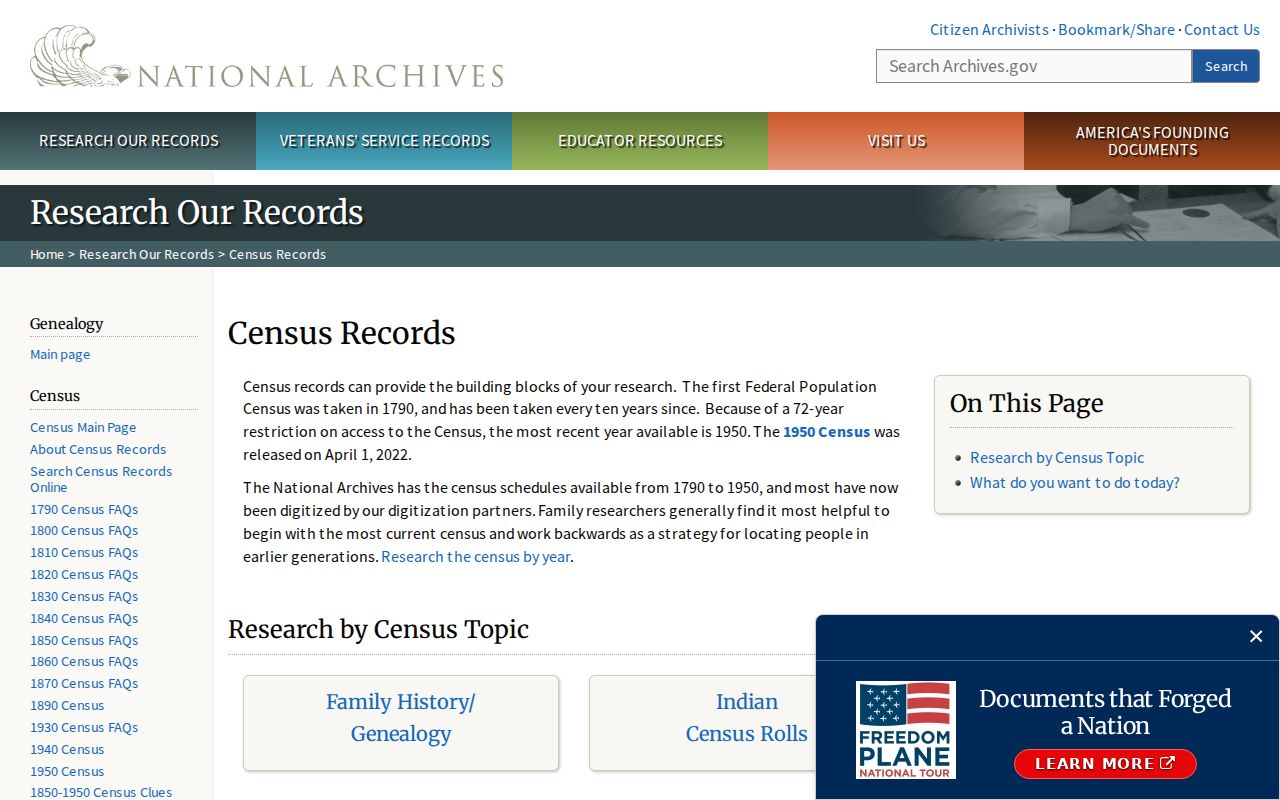
Census pages are strongest when they confirm a household pattern already suggested by a directory. A difference in names or ages is a prompt to check the image, not a reason to erase one source.
OCR Limits in National City Volumes
OCR can turn a name into a false lead. The 1892-93 material visibly mangles names and street spellings, especially where type is faint or a line joins two columns. Search several forms: initials and full given names, compound surnames, older punctuation, and a nearby street or business. Keep diacritics and Spanish name forms in mind, but do not infer identity or background from a surname.
Address words also carry period meaning. “Near Eighteenth” is not the same as a present parcel number, and a corner description may need the avenue and cross street in the correct historical order. Compare the scan with Sanborn, city maps, and a later reverse listing. If the printed page and OCR differ, quote the printed page and record the OCR spelling as a search variant.
A cautious local-directory citation keeps the title, year, section, page, printed name, and residence wording together. That makes the clue reusable when a later researcher checks it against a deed, newspaper, census page, or school annual.
The Next National City Archive Chapter
The local record story is still moving. The Kile Morgan room closed during 2010 budget cuts and reopened on June 2, 2014 with volunteer support. A digitization effort begun in 2017 had documented more than 800 objects in the cited fiscal-year report, including more than 700 photographs, 81 annuals, and 59 Kimball diaries. Those numbers explain why historical directory research may improve as scans, finding aids, and local descriptions become easier to connect.
The 2025/26 library strategy reports a collection assessment with SDSU and California Revealed, planned integration with the Online Archive of California, and expanded access to local-history material. Until that work supplies a fuller shelf description, the responsible approach is to name the confirmed run, ask staff about the exact item, and preserve the page image with the citation.
When a directory clue needs a present-day name match, the National City resident lookup page’s official-record workflow can test the clue against current court, vital, property, business, or license sources. The historical volume remains the starting point for the past, not a promise about a person’s present circumstances.